


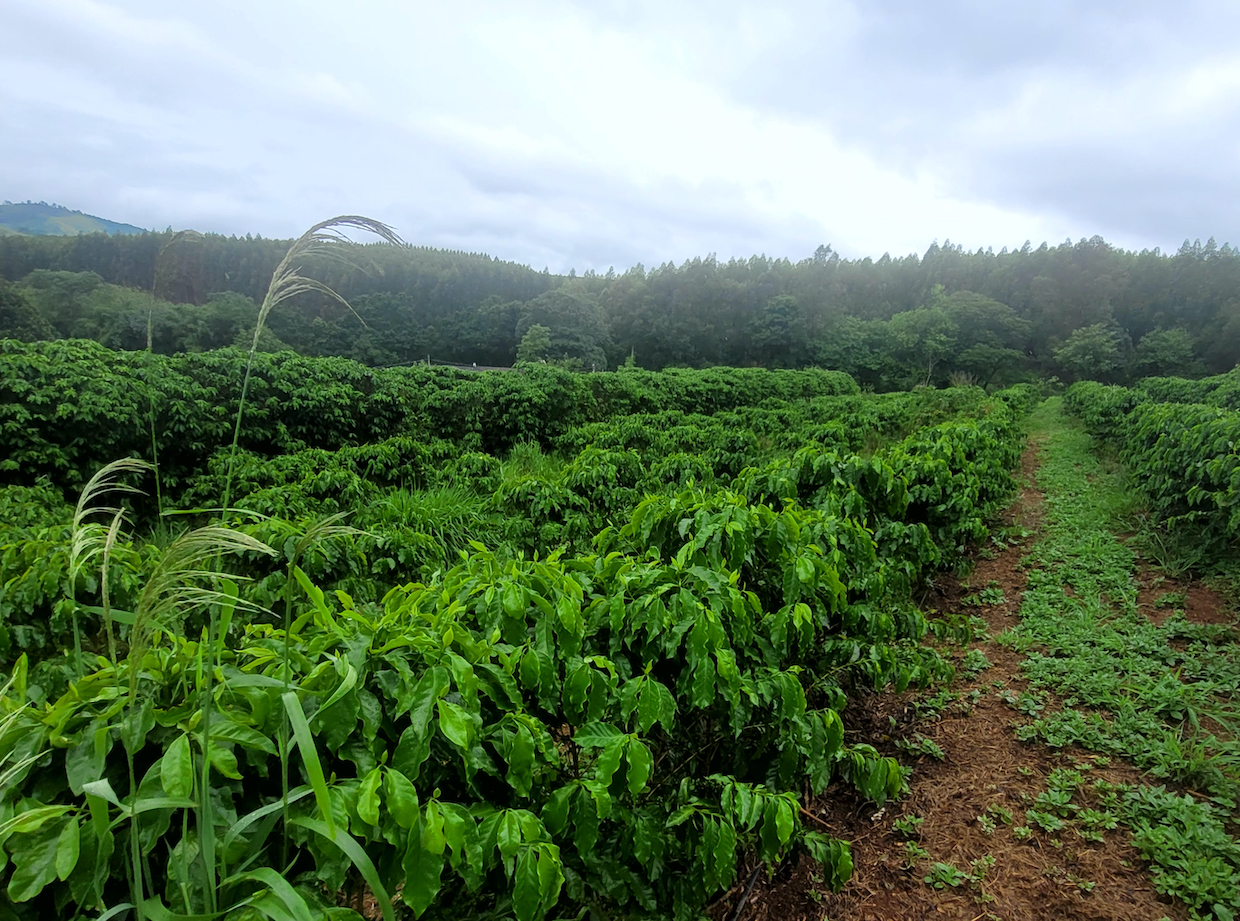
Photo by Jonas Ferraresso.
The challenges of producing coffee sustainably while maintaining good yields go far beyond financial considerations. While evaluating investments and profits in an unstable market certainly matters, the greater challenge is bridging the gap between technical possibilities and practical reality.
One of the realities of working in the field is that we often don’t do what’s best — we do what’s possible. Climate stress, labor shortages, commodity market fluctuations and inflation are obstacles producers face every day just to keep their operations running.
For more than a decade, I’ve worked with sustainable production systems — including organic, regenerative, agroforestry, biodynamic and various certification models — while also engaging with conventional and specialty coffee systems. One of the most important lessons I’ve learned is that, regardless of the management model, coffee must remain the protagonist of the production system if the goal is, in fact, to produce coffee.
This may sound obvious, but in practice it often isn’t.
Coffee as Protagonist
In many sustainability projects and certification programs I’ve worked with, this principle seems to get lost somewhere between manuals and action plans. It’s rarely intentional. In my view, it reflects a narrow view of the farm itself.
A coffee farm is a business, and it must be profitable. Only then can the capital it generates sustain and motivate the producer to keep improving and to offer the market better, more sustainable and more resilient coffees.

Photo by Jonas Ferraresso.
Producing more does not mean degrading more. Degrading more means producing at any cost.
I strongly believe that each coffee farm — and each producer — has a model that works best for their specific reality. Rigid, one-size-fits-all solutions may work to some extent, but they rarely achieve the main goal: keeping the producer within a sustainable system that is productive, viable and long-term.
However, if we consider coffee as the protagonist, there is a basic tripod of factors for achieving good yields and potential profitability while also maintaining sustainability:
- Soil quality: Chemically, physically and biologically healthy soil, with proper nutrition, structure and an active dynamic of transformation.
- Genetics: Coffea varieties that are well adapted and studied for the region, resistant to pests and diseases, vigorous and proven to yield well.
- Climate: Adequate rainfall and temperature for the varieties cultivated.
Everything we aim to build — success, sustainability, resilience and profitability — stems from this base.
Adapting Solutions to Reality
Consider the following three common scenarios that illustrate how these principles translate into practice.
Very hot regions, above the average for Coffea arabica
An agroforestry system can help moderate temperatures, but it requires careful planning. Spacing, tree species selection, sun exposure, planting density, labor availability for tree management and the behavior of the chosen variety under shade are all crucial to ensure the solution doesn’t become a new problem.
Not all varieties have been studied or adapted for shaded systems. In Brazil, after more than a century of research, Coffea arabica was adapted to low-phosphorus soils, full-sun cultivation and mechanized or semi-mechanized management — creating genotypes that are more robust and productive under these specific conditions. That’s why it’s essential to carefully analyze how to structure any agroforestry project before implementation.
Regions with mild temperatures but low rainfall (less than 1,000 mm per year)
Regenerative systems can be particularly effective here. Using organic matter, ground cover, green manures and efficient microorganisms helps retain moisture and maintain soil life.
Whenever possible, choose drought-tolerant varieties or grafted plants with vigorous root systems. Distributing fertility throughout the soil profile helps roots explore deeper layers. And if water is available — or can be stored during the rainy season — localized irrigation through drip systems can effectively complement the production strategy.
Regions suitable for arabica cultivation, but with low yields
In these cases, the answer often lies in the soil. Coffee plants depend not only on fertility but also on balanced nutrition. The lack of a single nutrient can limit the entire crop.
Poor soil preparation during planting, or low-quality seedlings from nurseries, are problems I frequently see in the field — and a poorly established plantation is almost impossible to fix. Unfortunately, sometimes only replanting can lead to good results.
Sandy soils, which tend to have low nutrient retention capacity, benefit significantly from increased organic matter levels to improve nutrient absorption and retention. Maintaining good soil cover also prevents leaching losses.
Simple Concepts, Complex Solutions
These examples illustrate something I often repeat: the concept is simple, but the solution is complex.
It’s common for a farm to have multiple problems that interact with one another — a natural condition in any agroecosystem. A hot climate might combine with poor soil structure and labor shortages. Low rainfall might coincide with inadequate variety selection and limited capital for irrigation.
That’s why my advice is: think of the coffee first. It’s the main focus for most producers. From there, build sustainable support systems that reinforce coffee’s role as the protagonist and keep the producer strong — producing with quality, profitability and responsibility.
Publisher’s note: Daily Coffee News does not engage in sponsored content of any kind. Any statements or opinions expressed belong solely to the authors and do not necessarily reflect the views of Daily Coffee News or its management.
Comments? Questions? News to share? Contact DCN’s editors here. For all the latest coffee industry news, subscribe to the DCN newsletter.
Related Posts
Jonas Ferraresso
Jonas Leme Ferraresso holds an agronomy degree from São Paulo State University (UNESP). He has worked as a coffee farmer, a coffee agronomist and as an advisor for several farms in Brazil.



Comment