

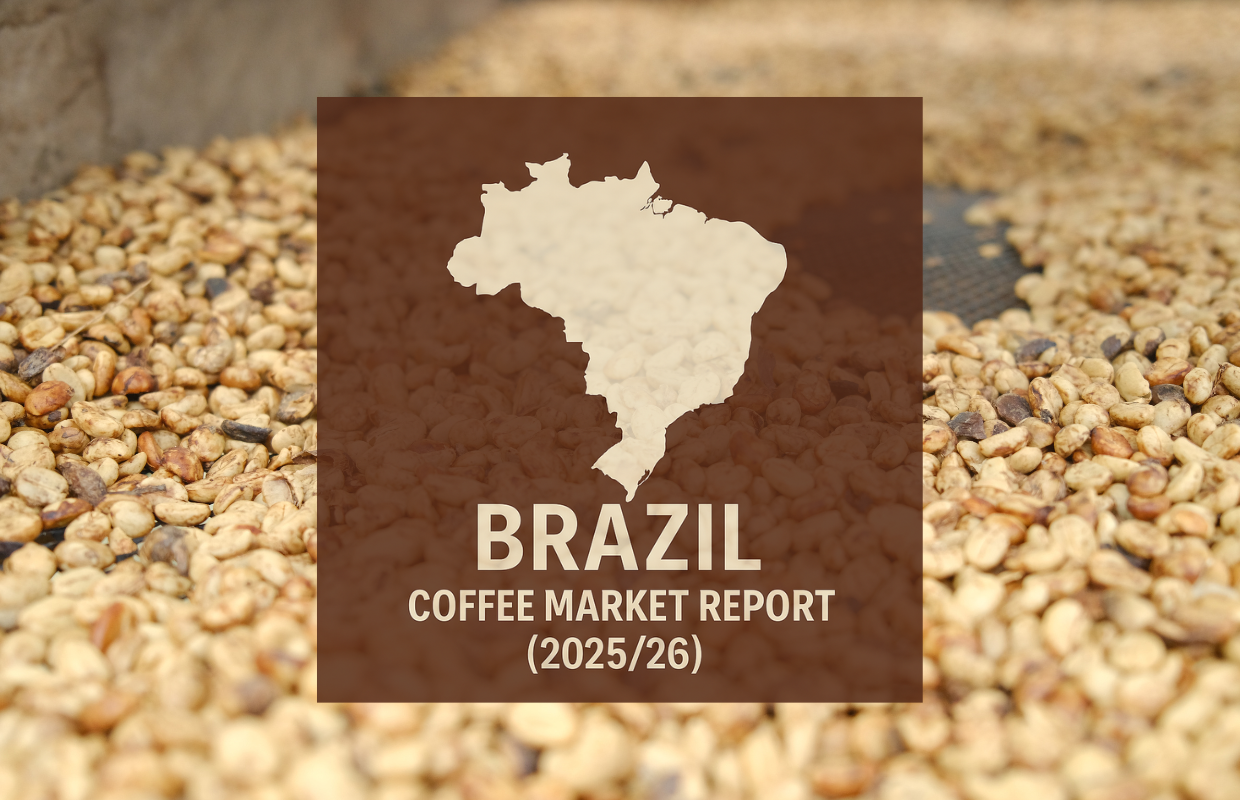
Brazil’s total coffee production for the 2025/26 market year (July to June) is now forecast at 63 million 60-kilogram bags, down about 3% from the prior season primarily due to adverse weather affecting arabica, according to the latest semi-annual report from the USDA Foreign Agricultural Service (FAS).
On the flip side, robusta production is now expected to reach a new record-high in Brazil, reaching approximately 25 million bags in 2025/26.
Total Brazilian coffee exports are expected to fall to 40.75 million bags, down from an estimated 44.75 million in 2024/25, with shipments to the United States hit especially hard by U.S. tariffs that peaked at a combined 50% beginning in August.
Despite the disruption of flow to the U.S., export revenues are rising sharply as global prices stay elevated and robusta demand grows, according to the analysis.
Meanwhile, ending stocks are projected at just 485,000 bags, offering little buffer for the world’s largest coffee supplier at a time when global production is racing to meet growing demand.
[Note: This is part of an ongoing series of DCN stories that explore USDA FAS country-level coffee reports, which are produced by different authors and field offices around the world.]
Arabica Production Down, Robusta Up
The FAS Brazil office now pegs Brazil’s 2025/26 coffee crop at 63 million bags, down from its earlier 65-million-bag projection.
The revision is driven by a steep cut to arabica, which is forecast at 38 million bags — more than 13% lower than last season — after below-average rainfall and heat stressed trees in key states such as Minas Gerais and São Paulo, particularly during flowering. 2025/26 also represents the down year in Brazil’s biennial production cycle.
However, production of robusta is now forecast at 25 million bags, up 19% from the estimated 21 million in 2024/25, supported by favorable weather and widespread irrigation in Espírito Santo and Bahia. FAS notes that high prices in recent years have allowed many growers to invest in new plantings and farm improvements, which could support the 2026/27 crop if upcoming rains cooperate.
The FAS forecast is notably higher than Brazil’s own official agencies. The National Supply Company (CONAB) most recently raised its 2025/26 estimate to about 55.3 million bags — roughly 35 million arabica and 20 million robusta — while the Brazilian Institute of Geography and Statistics (IBGE) is near 56.8 million bags. Both agencies have historically come in below FAS, which uses different survey and modeling methods, a point the report itself emphasizes.
Exports Altered by U.S. Tariffs, Though Revenue Up
On trade, FAS has trimmed its 2025/26 export forecast to 40.75 million bags. That is about 2.4% below the previous FAS projection and almost 9% below the 44.75 million bags now estimated for the previous year 2024/25. The report ties the decline to diminished stocks and the Trump administration’s tariffs on Brazilian coffee.
Data from the Brazilian Coffee Exporters Council (CECAFE) highlights that shift. From January through September 2025, Brazil shipped 29.1 million bags of all coffee types, down 20.5% from 36.6 million bags in the same period of 2024. Over that stretch, however, export revenue jumped 30% to about US$11.05 billion due to higher prices.
The United States remains Brazil’s largest buyer year to date, importing 4.361 million bags in the first nine months of 2025 — about 15% of Brazil’s total — but volumes are nearly 25% lower than a year earlier. In September, U.S. imports from Brazil fell more than 50% versus September 2024, pushing the U.S. to third behind Germany and Italy for the month.
Domestic Grows but Brazilians Feeling Higher Prices
Brazil remains the second-largest global consumer of coffee behind the U.S., a fact that complicates the country’s production and export dynamics.
FAS maintained its forecast for Brazil’s domestic coffee consumption in 2025/26 at 22.28 million bags, including 21.3 million bags of roasted and ground coffee and 980,000 bags of soluble.
However, future behavior may be reshaped by higher domestic prices. The Brazilian Coffee Industry Association (ABIC) recently reported that retail coffee prices have climbed more than 70% over the past two years, with soluble, traditional and gourmet coffees all seeing double-digit increases.
Prices and Stocks
Wholesale and farmgate prices remain volatile but elevated. According to the FAS report, data from the University of São Paulo’s CEPEA indicates arabica averaged about BRL 2,234 (roughly US$415) per 60-kilogram bag in September 2025, around 50% higher than a year earlier. Robusta prices reached historic highs in January and stayed elevated through the early months of 2025.
In the meantime, Brazil’s coffee stocks remain very low by historical standards, with FAS estimating ending stocks at just 485,000 bags in 2025/26, up slightly from 440,000 bags in 2024/25 but still well below the more than 2 million bags reported just two years earlier.
Brazil’s outsized status as a global producer combined with such a low cushion help to explain why analysts and markets react so strongly to weather reports in Brazil.
Comments? Questions? News to share? Contact DCN’s editors here. For all the latest coffee industry news, subscribe to the DCN newsletter.
Related Posts

Comment