

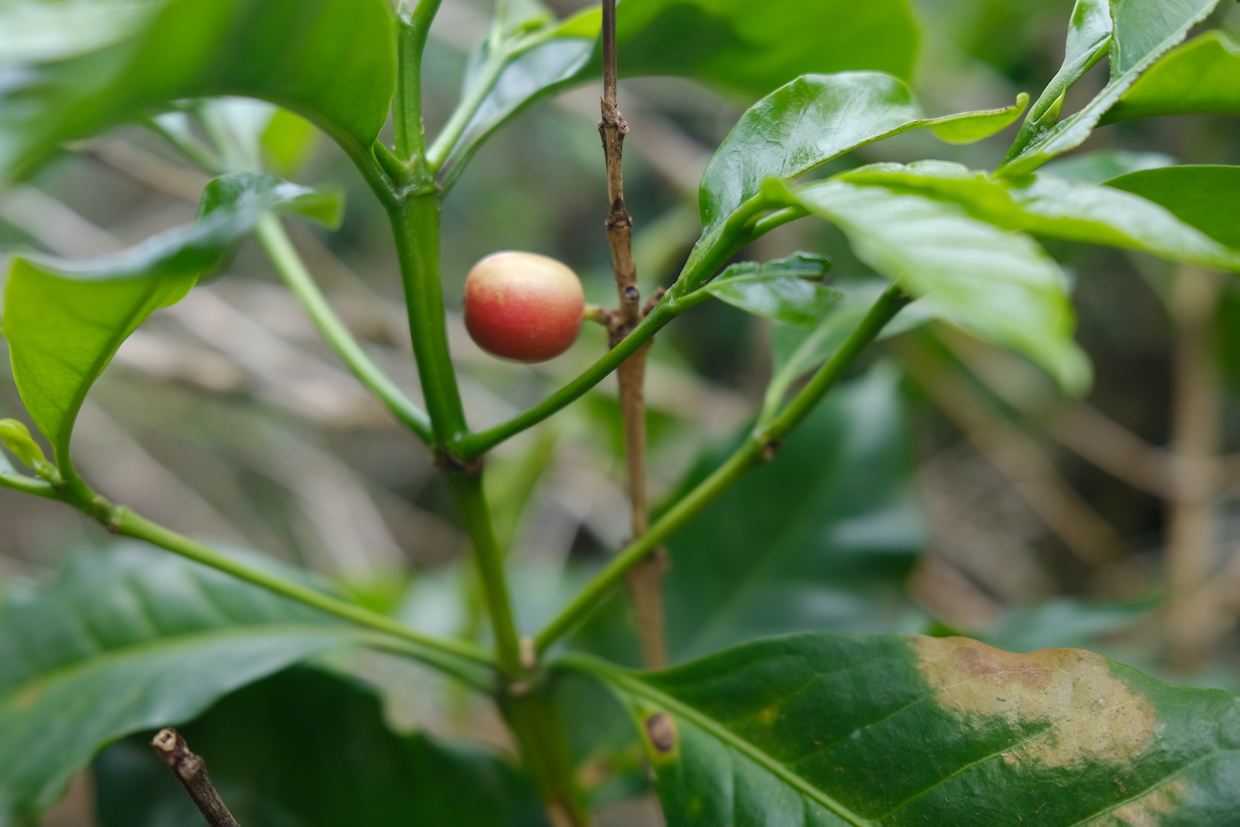
Coffee growing under shade. Daily Coffee News photo by Nick Brown.
A new open-access dataset called Sample Earth aims to fix what its creators call a critical flaw in the global coffee and cocoa trade: maps that label current smallholder farms as forests.
Launched last week by the Alliance of Bioversity International and the International Center for Tropical Agriculture (CIAT), Sample Earth is a reference dataset designed to help mapmakers stop misclassifying potentially hundreds of thousands of smallholder coffee and cacao farms as forest land.
The distinction is timely as the Dec. 30 enforcement date for the European Union Deforestation Regulation (EUDR) looms. The law will require European companies to ensure certain agricultural goods are not linked to specific instances of deforestation.
Toward a ‘Universal Standard’
According to the groups behind Sample Earth, inaccurate mapping could cut hundreds of thousands of coffee and cocoa farmers out of the European market as EUDR kicks in. They said the reference dataset, hosted at the Harvard Dataverse, draws on more than two decades of Alliance research using satellite imagery to monitor land-cover changes across the Global South.
“Currently, no universal standard exists for third-party accuracy assessments of maps used in deforestation due diligence,” the groups said in a joint announcement of the launch. They said the reference tool is designed to “set a new transparency and quality benchmark for map-based compliance” while including built-in improvement mechanisms that allow mapmakers to access confidential land-use data without exposing individual farmers’ locations.

“Most maps are not accurate at local scales because the data is biased toward regions with a lot of training data,” Thibaud Vantalon, a scientist at the Alliance of Bioversity International said in an announcement from the group. “Remote regions are very poorly mapped. Sample Earth means to fill this gap in training data for smallholders.”
As one example, the groups pointed to the EU’s main reference map for the regulation, published in 2025, saying it misclassifies more than half of the coffee production zones in Colombia, China, Guatemala and Mexico as forest, according to Alliance data.
“Maps are needed for due diligence, and buyers will likely steer clear of areas misclassified as ‘high risk’ for deforestation,” Louis Reymondin, a data scientist at the Alliance, said. “With Sample Earth, we invite governments, companies, NGOs and research institutions to invest in expanding this inclusive, high-quality land-cover reference to preserve livelihoods and incentivize environmental protection.”
Where EUDR Stands
EUDR has become one of the most contentious pieces of legislation affecting the coffee industry.
After multiple enforcement delays since the law passed in 2023, EU member states said last week they intend to push enforcement back another year, to December 2026 for large organizations and June 2027 for smaller ones. (The delay still requires European Parliament approval.)
Noting the rapid loss of the world’s tropical forests, certain environmental groups and civil society organizations have criticized the delays.
Attitudes toward the legislation in the coffee industry are mixed. Some companies recently voiced support for the current enforcement timeline based on their investments in compliance, while others have maintained that the law is flawed, potentially resulting in unintended consequences for smallholders.
Comments? Questions? News to share? Contact DCN’s editors here. For all the latest coffee industry news, subscribe to the DCN newsletter.
Related Posts
Nick Brown
Nick Brown is the editor of Daily Coffee News by Roast Magazine.



Comment