

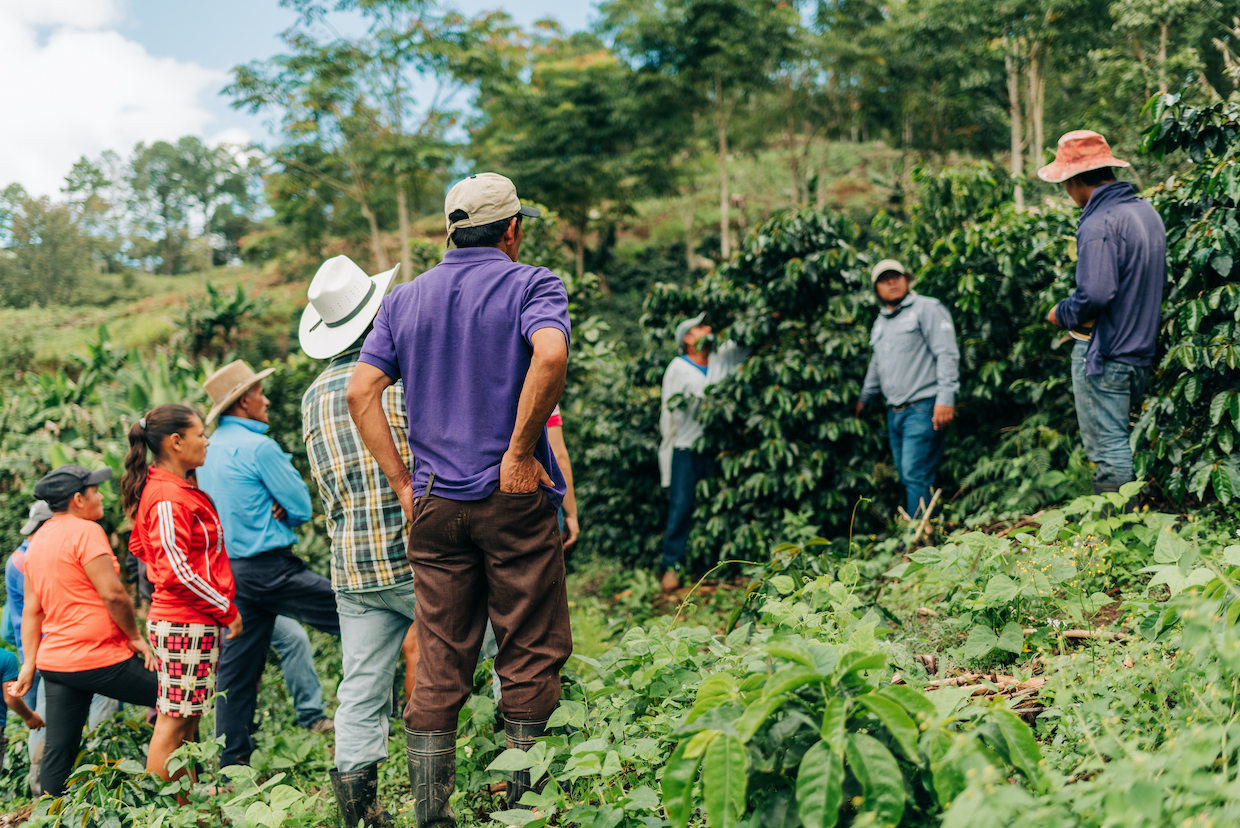
A training group in a TechnoServe coffee program in Comayagua Department, Honduras. TechnoServe photo by Olivia Sakai. Used with permission.
TechnoServe, one of the longest-running and farthest-reaching nonprofits operating in the coffee sector, recently announced it has helped train more than 1 million smallholder coffee farmers.
Since launching its first coffee training programs in 2009, the Virginia-based organization dedicated to addressing the world’s poverty crisis has leaned into agronomy training in 16 coffee-producing countries with programs built to improve coffee quality, yields and farmer livelihoods.
The work, affecting some 660,000 households in coffee communities, has come against a turbulent geopolitical backdrop. These days, conflict, climate shocks and rising inequality are colliding with shrinking aid budgets, fractured corporate sustainability goals and isolationist policies that threaten traditional international development operations.
TechnoServe’s Paul Stewart has been navigating both the bureaucratic terrain and the actual coffee lands through numerous roles over the past 23 years, including the past nine as the organization’s global director of coffee.
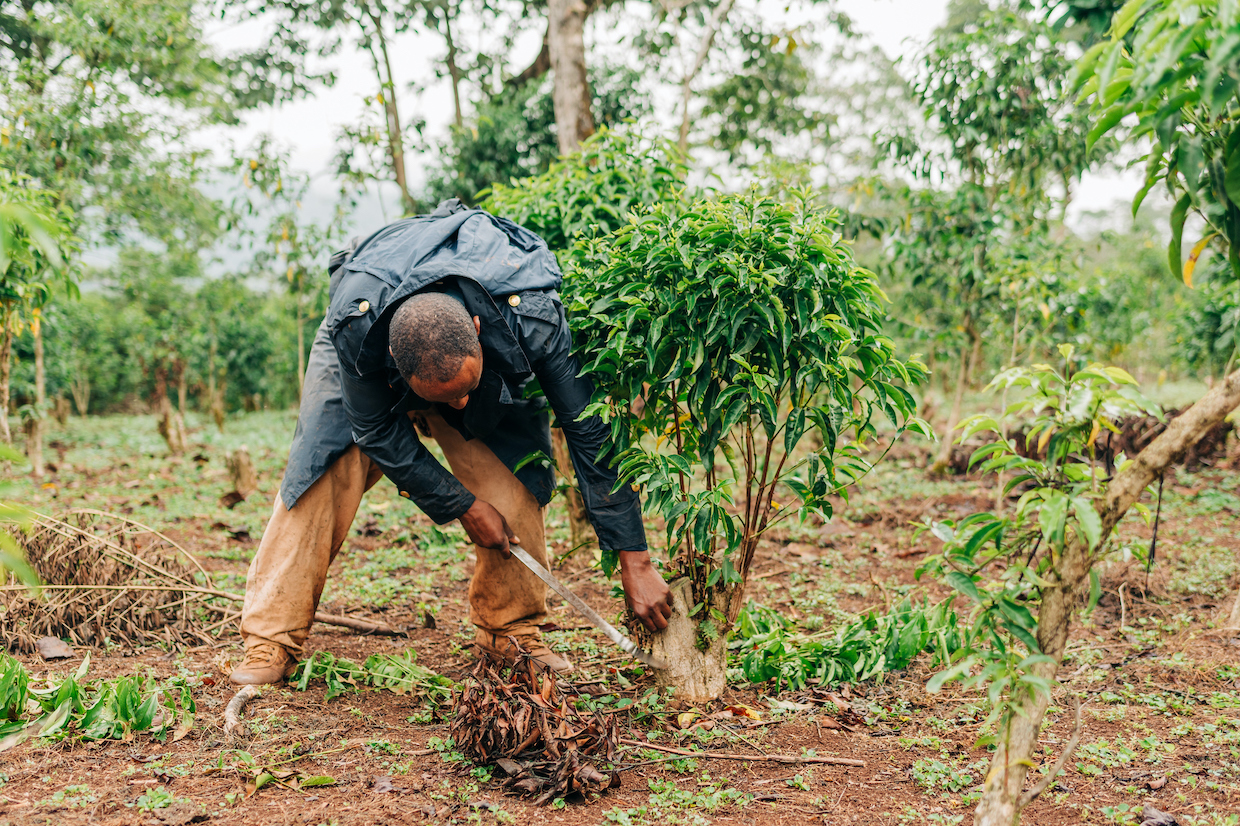
Adugna Feye, a member of the Nano Chala cooperative in Ethiopia, graduated from a TechnoServe agronomy program. TechnoServe photo by Olivia Sakai. Used with permission.
What follows is part one of our two-part interview with Stewart, where we explore development programming and operations, scalability and partnership structures. In part two, Stewart will address the poverty paradox that continues to plague the coffee sector, as well as today’s dynamic development landscape.
Certainly, with 1 million coffee farmers trained, there must be lessons — both encouraging and difficult — that the coffee industry may embrace as we head into 2026.
Daily Coffee News: In your experience scaling farmer training from pilots to multiyear programs involving potentially thousands of farmers, what are two or three overarching strategies you’ve found that consistently move the needle on quality and yield?
Paul Stewart: The key to improved quality and yield is the adoption of good agricultural practices by smallholder farmers. Over the course of training a million farmers, we’ve identified a few critical drivers for higher adoption rates. First, we’re careful to focus on regenerative practices that are cost-effective for smallholders, particularly those that save them money — for example, using integrated pest management rather than pesticides. There’s lower resistance to change when the business case is clear to the farmer.
Beyond that, there are elements in how we deliver training that we think are important. We provide hands-on training, timed to coincide with the agricultural calendar, so that farmers can apply them almost immediately. Additionally, our training programs always include farmers practicing each new technique on a plot where they get to watch the transformation from an average coffee plot to a highly productive demonstration plot. Farmers often tell us some variation of ‘seeing is believing.’
Finally, our Coffee Farm College is a two-year program, with the second year of training reinforcing adoption of these practices.
Are there specific types of interventions that appear promising on paper, but consistently fail at scale, either with TechnoServe or elsewhere? Similarly, are there specific interventions that private partners are drawn to yet may not be advisable?
There’s a lot of excitement around digital training for coffee farmers, but I don’t think the results really support it. YouTube videos, social media, and SMS messages have been an effective supplement to our in-person training in Latin America, but I have trouble envisioning a fully remote program that delivers real impact. First, just practically, many smallholders don’t have access to smartphones or mobile internet. When we looked at this a few years ago, our leadership in the field estimated that only about 20% of the coffee farmers in our program had reliable access to the internet.
That will obviously improve over time, but even when it does, I think digital engagement makes sense as a supplement to in-person training rather than a replacement. The practical experience from hands-on training, sharing among peers, and being able to see the impact on the demonstration plot over time are really critical elements.
More broadly, efforts to replicate projects that succeeded in one context tend to fail when they don’t account for the needs and opportunities in the new context. For example, I recently saw a program that helped coffee farmers diversify their incomes being replicated in Kenya. But coffee farmers in Kenya are already highly diversified, and the greatest opportunity is to transition to regenerative coffee farming. I’ve also seen efforts to replicate programs aimed at reducing carbon emissions in farming communities where carbon emissions are already near zero!
What have been some of your major findings regarding efficiency and impact? If you had to cut a specific program cost in half tomorrow yet sought the same outcomes, what elements would you fight to keep first?
We are constantly working to identify what drives impact in our projects and how we can provide it as efficiently as possible. For example, something I would definitely fight to keep are locally recruited farmer trainers. They come from the communities they serve and are often the daughters and sons of coffee farmers. Their knowledge of their community — and the enthusiasm with which they help farmers — is fundamentally what makes our projects work in the field.
Providing constant in-person supervision for large field teams is really costly, so we use digital monitoring systems, including GPS and photos, to track their progress without incurring a large expense.
“Lasting impact” is a major consideration in the NGO world, and something NGOs and private partners have routinely been criticized for. What would you say are the one or two biggest factors that determine long-term impact, and how has TechnoServe adapted to that over the years?
That’s absolutely right; lasting impact is really how economic development projects ought to be judged. It’s something we take very seriously. Ultimately, lasting impact for coffee farmers depends on the sustained adoption of good agronomy practices. To achieve that, farmers need effective, hands-on training and market dynamics that reward farmers for improving their yield and quality.
Ex-post analyses that measure the lasting impact of development projects are not as common as they should be. However, when researchers looked at the impact of our Coffee Initiative program in Rwanda, they found that five years after training ended, 78% of participating farmers were still using at least half the practices they had been taught — down from 97% at completion of training, with the fall primarily driven by farmers no longer keeping records.
Pulling back a little and looking at the ecosystem, it’s also really important that there are people and institutions — extension officers, cooperatives, and private-sector service providers — that remain active in the community providing high-quality inputs and access to high-value markets. One of the most gratifying things about the last 15 years is seeing the many dedicated people who worked as farmer trainers and business advisors in our programs who are now working in the local coffee sector, supporting farmers.
In a general sense, what does an effective program partnership look like? Is there some kind of winning formula between industry actors, NGOs, in-country partners, governments?
No two partnerships look exactly the same, but there are a few factors we see frequently playing an important role. Co-funding is often critical to making a partnership work: a lot of our work recently has involved a donor government and corporate partner investing jointly in a program. This also reflects the reality that a good coffee agronomy program generates societal and environmental benefits in addition to commercial benefits for the coffee industry.
Second, effective programs must be focused on the specific challenges and opportunities faced by the farmers, which can be completely different across regions of the same country.
Third, buy-in from local actors — local government officials, national coffee institutions, local influencers — is essential, as this ensures a unified voice. Farmers will never adopt new techniques if they receive contradictory messages.
How is the potential value from a ‘well-designed’ program distributed?
Effective programs are a win-win-win for producing country governments, coffee companies and farming communities. Governments gain from increased export revenues and a growing coffee sector, coffee roasters and exporters gain from having access to more coffee, and coffee farmers and their communities gain the most as they capture the highest share of value from increased coffee production with the multiplier effect creating catalytic rural economic growth.
I witnessed an incredible example of this in a remote village in western Ethiopia where 15 years ago we supported a group of coffee farmers to set up the Duromina cooperative wet mill. Previously, they had sold low-quality sun-dried coffee to middlemen traders and the wet mill allowed them to produce fully washed coffee that turned out to be one of the best quality coffees in the country.
After their first year, they used their profits to build a bridge over a river that would give them better access to markets. Over a couple of years, the cooperative then built a new health clinic and expanded their school. Individual farmers used their higher incomes to send their children for higher education. New businesses popped up in the village and the community is thriving.
Are there specific program governance choices — such as data sharing, price transparency, risk acceptance — that are essential to a partnership to determine the efficacy of a program? Similarly, are there any specific elements you insist on now — particularly among industry partners — that you might not have insisted on a decade ago?
Data sharing is really critical. It’s something our industry partners expect of us, obviously, but also their data is enormously helpful in our work. Earlier this year, we released the Regenerative Coffee Investment Case, which looked at the potential benefits for farmers, industry, and the planet that could be unlocked with greater funding to help smallholders adopt regenerative practices. That research was made possible, in part, by farm-level data from our partners.
[Editor’s note: The headline of this story has been updated since its original publication to better reflect the number of coffee farmers trained through TechnoServe programming.]
Comments? Questions? News to share? Contact DCN’s editors here. For all the latest coffee industry news, subscribe to the DCN newsletter.
Related Posts
Nick Brown
Nick Brown is the editor of Daily Coffee News by Roast Magazine.


Comment