

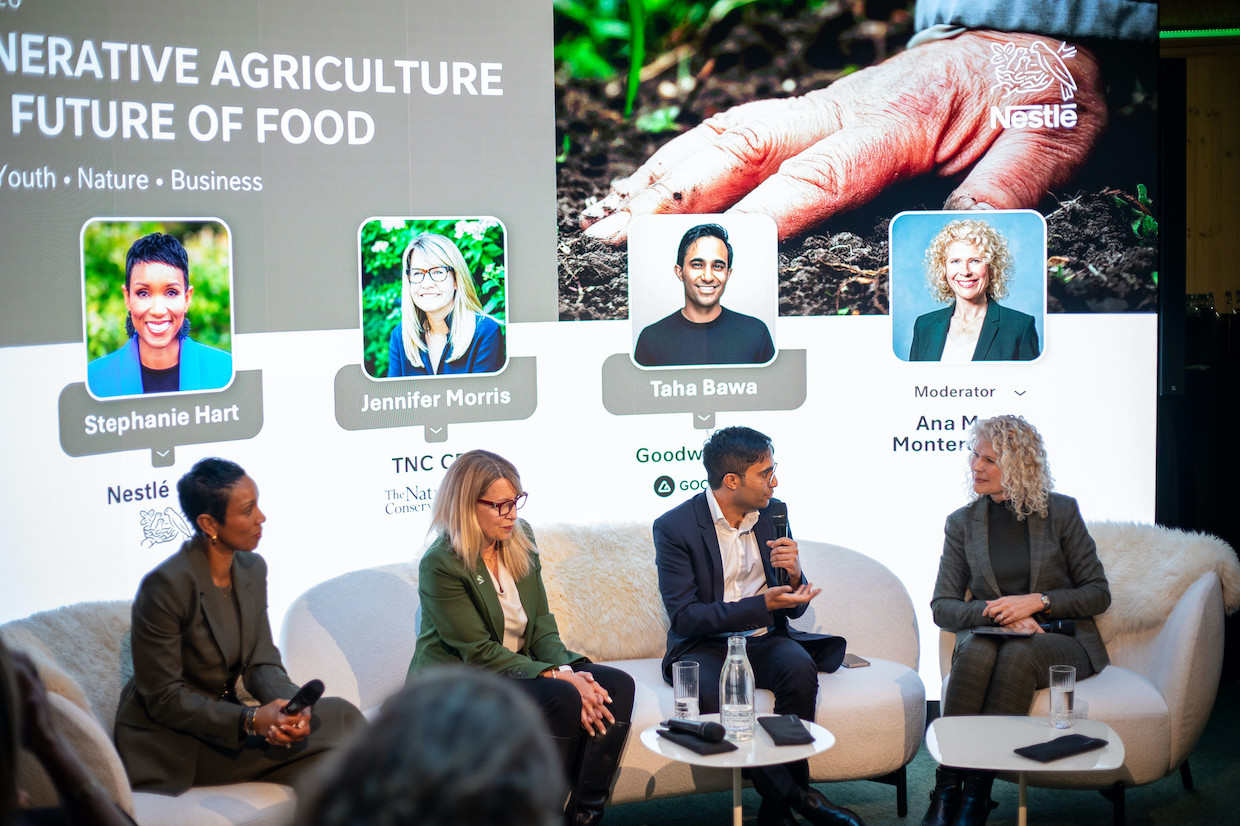
Representatives of Nestlé, The Nature Conservancy and Goodwall in Davos. Nestlé press photo.
Global food giant Nestlé is launching two new collaborations designed to scale regenerative agriculture globally while attracting more young people into farming.
The initiatives — one in collaboration with The Nature Conservancy and the other with the youth-learning platform Goodwall — were formally unveiled at the recent World Economic Forum Annual Meeting in Davos, Switzerland.
Stakeholder and Youth Engagement
According to Nestlé, the collaboration with The Nature Conservancy builds upon the existing “Nestlé Agriculture Framework,” a corporate plan designed to help farmers improve crops, earnings and environmental outcomes. Nestlé said the partners will now seek to refine and expand that framework and encourage “more industry stakeholders” to participate.
Separately, Nestlé said it will support Goodwall in building an agriculture curriculum that uses gamification to increase awareness of regenerative agriculture and teach “practical skills” to young people through the Goodwall app.
Nestlé did not disclose financial terms associated with either partnership.
Coming from the world’s largest food and beverage company, the announcement signals how “regenerative agriculture” has moved from a niche, often loosely defined idea to a mainstream corporate priority.
While Nestlé framed the Davos partnerships as a step toward making regenerative agriculture “the norm” across its sourcing footprint, the press release offered few specifics on which crops, origins, farmer groups or verification methods will be involved.
Regenerative Coffee
In coffee specifically, “regenerative” has increasingly migrated from broad sustainability rhetoric into consumer-facing claims and third-party programs. Rainforest Alliance rolled out a regenerative standard for coffee in September 2025, and Nestlé-owned Nespresso has said it plans to be the first brand to bring Rainforest Alliance Regenerative certified coffee to market, with a certification seal expected on select products this year.
Nestlé and Nespresso helped fund a report launched by a separate nonprofit, TechnoServe, last May, that modeled a potential seven-year, $4 billion investment in regenerative agriculture in coffee. Called “The Regenerative Coffee Investment Case,” the report found that transitioning to regenerative agriculture in major growing countries outside of Brazil and Vietnam could increase smallholder coffee farmer income by an average of 62% and boost production and exports by approximately 30%.
The report called for substantial private-sector investment in regenerative agriculture, as well as collaboration among “investors, industry, government and service providers.”
Notably, Nestlé recently signaled it is exploring the sale of California-based Blue Bottle Coffee, which in 2025 stated plans to invest in regenerative agriculture. Nestlé acquired Blue Bottle in 2017.
Comments? Questions? News to share? Contact DCN’s editors here. For all the latest coffee industry news, subscribe to the DCN newsletter.
Related Posts
Nick Brown
Nick Brown is the editor of Daily Coffee News by Roast Magazine.



Comment