

JDE Peet’s logo
Coffee giant JDE Peet’s today announced its “Nature Transition Plan,” described as a companywide roadmap designed to expand regenerative agriculture programs and accelerate “deforestation-free” coffee sourcing.
Coming less than a week after Swiss food giant Nestlé unveiled a global “regenerative agriculture” campaign, the JDE Peet’s announcement underscores the transition of regenerative agriculture from a niche concept tied to specialty markets into a central tenet of corporate sustainability in coffee.
The grand plan unveiled by JDE Peet’s aims to expand the adoption of regenerative coffee farming practices across an additional 200,000 hectares by 2030. The company also said it intends to move toward 100% “responsibly sourced” green coffee by 2028, building on a reported 83.2% achieved in 2024. Notably, JDE Peet’s previously set a goal of reaching 100% “responsibly sourced” green coffee by 2025.
For its corporate sustainability playbook, JDE Peet’s said the supply chain transition plan, called “Grounded in Nature,” will be aligned with numerous third-party frameworks and sustainability targets, including the Taskforce on Nature-related Financial Disclosures framework, the Kunming-Montreal Global Biodiversity Framework and the Science Based Targets Network.
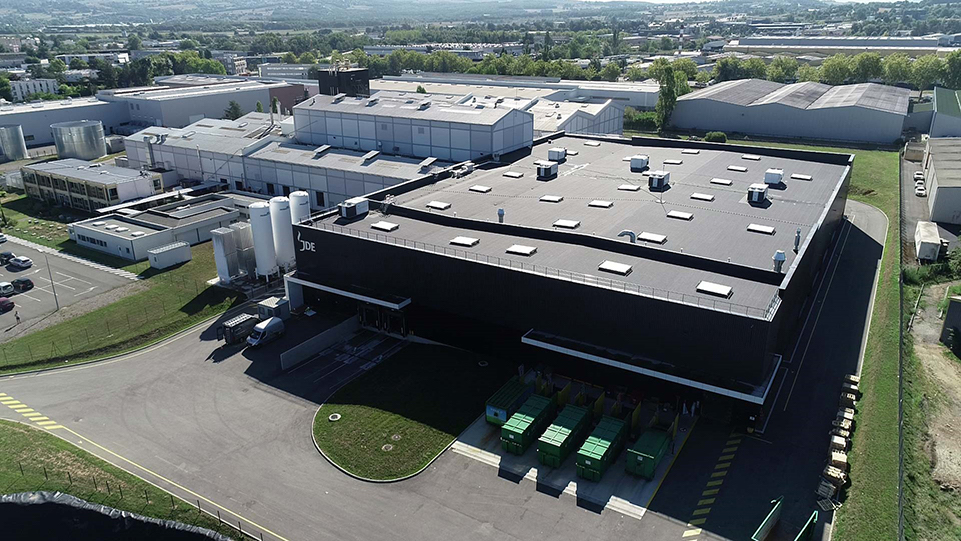
A JDE Peet’s factory in France. JDE Peet’s Media Kit photo.
The announcement lands amid a broader wave of “regenerative” claims in food marketing and corporate sustainability messaging, even as the term remains inconsistently defined, difficult to verify and potentially linked to corporate greenwashing.
The original definition is typically attributed to Robert Rodale of the Rodale Institute in the 1980s, focusing on soil biology as the key to supporting nutrient recycling between plants, animals and the land, leading to healthier crops and improved economic productivity without agricultural chemicals.
In coffee specifically, new standards for regenerative agriculture have emerged alongside marketing efforts. The Rainforest Alliance has said a distinct regenerative seal for coffee is expected to begin appearing on consumer packaging in 2026, while Nestlé-owned Nespresso has said it plans to be the first brand to bring Rainforest Alliance Certified Regenerative coffee to market.
JDE Peet’s currently purchases approximately 8% of the world’s green coffee, according to the company’s own estimates. The conglomerate owns major coffee brands across numerous market segments, including Peet’s Coffee, L’OR, Jacobs, Gevalia, Douwe Egberts, plus Peet’s subsidiaries Intelligentsia Coffee and Stumptown Coffee Roasters. The group also holds a long-term license for Caribou Coffee products.
The timing of the “Grounded in Nature” plan is particularly notable as JDE Peet’s is currently in the process of being acquired by Keurig Dr Pepper in an approximately $18 billion deal, with plans to form a mega coffee conglomerate called Global Coffee Co.
“Without nature there is no coffee,” Laurent Sagarra, vice president of engagement at JDE Peet’s, said in an announcement today. “Our Nature Transition Plan is both a clear roadmap, and a call to action for the coffee industry to work together with governments, NGOs and coffee farmers to bend the curve on biodiversity loss and secure the future of coffee. By protecting nature, we protect coffee, communities and the shared future of our industry.”
Comments? Questions? News to share? Contact DCN’s editors here. For all the latest coffee industry news, subscribe to the DCN newsletter.
Related Posts
Nick Brown
Nick Brown is the editor of Daily Coffee News by Roast Magazine.



Comment