

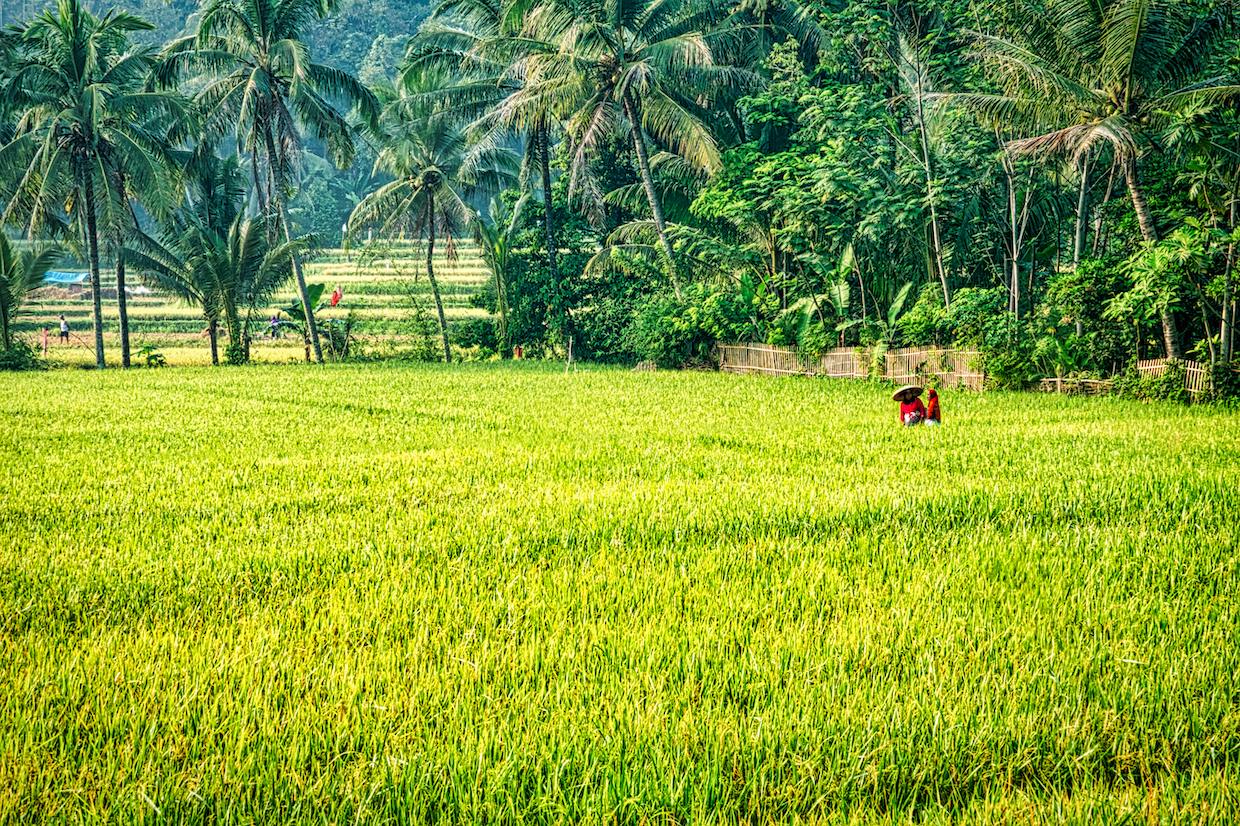
A rice field in West Java, Indonesia. The new EU-funded initiative affects the coffee, cocoa, rice and sugar sectors.
Fairtrade International and Indonesian NGO Bina Desa are launching a four-year, €1 million (US$1.15 million) program to help smallholder farmers in Indonesia adapt to climate change, meet new sustainability regulations and improve incomes.
DCN has confirmed that the project is focused on the coffee, cocoa, rice and sugar sectors on the islands of Java and Sulawesi.
Funded by the European Union’s Civil Society Organisations Thematic Programme, the project will run from November 2025 through October 2029, affecting more than 1,600 smallholder farmers, at least 30% of whom are women. The project also calls for participation among local community groups, youth and local authorities.
Called “Transitioning Towards Green Resilience: Building Inclusive and Sustainable Agricultural Communities,” the initiative is designed to provide training on climate-resilient and organic farming, gender equality and basic financial skills, according to Fairtrade International.
The project will also help producer groups pursue organic certification and other strategies to reach higher-value markets.
A second workstream focuses on farmer organizations, offering business development coaching, small sustainability grants and advocacy training. A third aims to build demand and policy support through consumer campaigns, producer-buyer matchmaking and dialogue with government agencies.
“This four-year program is a major step toward helping smallholder farmers, especially women, adapt to climate change and strengthen their cooperatives,” said Bindu Sukumarapillai, CEO of the Fairtrade Network of Asia Pacific Producers (NAPP).

A flowering coffee plant in Indonesia.
The project is framed as supporting Indonesia’s “Just Green Transition” — an effort to move toward a lower-carbon economy without leaving rural communities behind — and aligns with Presidential Instruction No. 9/2025 to revitalize rural cooperatives and village economies.
Additionally, the project is designed to address requirements set forth in the new EU deforestation-free regulation (EUDR), although the scheduled enforcement of that law remains uncertain.
Recent reports on the coffee sector in Indonesia highlight both pressure and promise, with mounting concerns over climate volatility and production costs combined with increased global demand for high-quality, traceable, differentiated coffees. One recent project among coffee farmers in Sumatra saw significant gains through agroforestry and organic practices, which eliminated the need to pay higher fertilizer costs.
In its announcement, Fairtrade promoted the project as a means to inspire locally driven change through inclusivity.
“This project gives smallholder farmers and rural communities a stronger voice in shaping their future,” said Bina Desa program coordinator Armin Salassa.
Comments? Questions? News to share? Contact DCN’s editors here. For all the latest coffee industry news, subscribe to the DCN newsletter.
Related Posts



Comment