


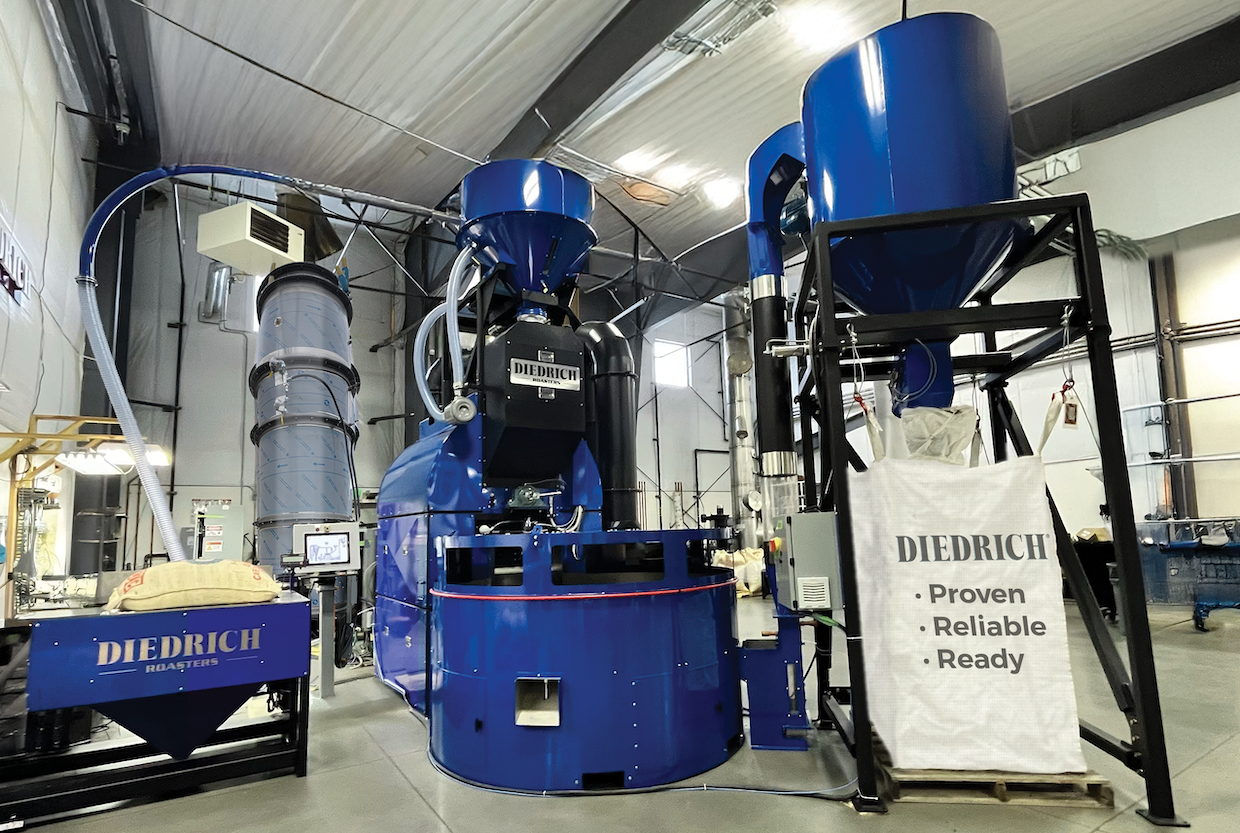
The new Diedrich Roasters DR-280 machine. Images courtesy of Diedrich Roasters.
Idaho-based equipment maker Diedrich Roasters recently introduced a substantially upgraded version of its four-bag industrial roaster, the Diedrich DR-280, as part of a new line of four- and six-bag machines aimed at larger commercial coffee operations.
Manufactured in the United States, the new DR-280 accepts 280 kilograms (617 pounds) of green coffee per batch, with throughput up to 2,156 pounds per hour, according to company materials. The machine is also designed to handle half batches.
Diedrich has built and delivered “four-bag” roasters since 2003 to roasteries in both domestic and international markets, several of them equipped with infrared burners. With the new DR-280 and its larger six-bag sibling, the DR-360, the company has moved to more efficient air-heating units paired with a pressure-balanced burner box.
The shift is designed “for better thermal efficiency, controlling the inertia within the roasting drum and allowing for optimal responsiveness of the burner control system,” Diedrich Roasters spokesperson Launtia Taylor recently told Daily Coffee News.
At the heart of the redesign is a new drum and airflow system intended to improve heat transfer and efficiency. Taylor said the updated geometry and ducting support more efficient airflow during roasting, along with improved control over convective and conductive heat at lower air-supply temperatures. Enhanced insulation throughout the roaster housing, burner box and process ductwork is meant to help stabilize the system while reducing energy loss.

On the controls side, the DR-280 platform is built on an Allen-Bradley Rockwell architecture, with automation and integration handled in-house by Diedrich’s engineering team.
The company says the new control package offers tighter, more stable profile tracking and the ability to compensate for seasonal temperature swings or differences between the first and last batches of a roasting shift. Optional connections to third-party software such as Cropster and Artisan provide a secondary path for logging and analyzing roast data.
Safety and uptime were also priorities. The new roasters offer process and emergency quenching for the drum, cyclones and cooling tray, along with cooling tray designs that can be configured in updraft or downdraft arrangements.
Taylor said the system has been engineered to extend the time between cleaning cycles while maintaining safe operation. Customers can order either recirculating or non-recirculating airflow configurations, with thermal or catalytic afterburners available on request.
Diedrich is positioning the DR-280 and DR-360 as production anchors for roasteries that have moved beyond traditional 35-, 70- or 140-kilo machines but aren’t yet operating at commodity-scale volumes.
“Four-bag and six-bag roasters are built to service and supply the mid-market segment,” Taylor said.
Comments? Questions? News to share? Contact DCN’s editors here. For all the latest coffee industry news, subscribe to the DCN newsletter.
Related Posts

Comment